
Here's a situation that happens more often than people talk about: a reseller has a solid month. Margins are good. Items are moving. They check their profit tracker and they're up $2,000 for the month. Then they check their bank account and realize they're somehow lower than they were 30 days ago.
This isn't a math error. It's the cash flow trap, and it catches a lot of resellers, especially when they start scaling up.
Understanding why it happens, and how to manage around it, is one of the things that separates resellers who build a sustainable business from resellers who burn out after a year of profitable but stressful selling.
Profit and Cash Are Not the Same Thing
This is the core of the issue. When you're tracking profit, you're looking at revenue minus cost of goods. You bought something for $10 and sold it for $40 after fees. That's a $30 profit. Simple.
But cash flow is about timing. That $10 you spent on inventory left your bank account the moment you bought it. The $40 (minus fees) doesn't arrive in your account until the item sells, ships, and eBay or Amazon releases the funds. Depending on your platform and payout schedule, that might be 3 days after delivery, or it might be 10 to 14 days.
During that gap, your money is frozen in inventory. If you keep buying without accounting for that gap, you can be technically profitable while being genuinely cash-strapped.
Add platform holds for new sellers, a slow week of sales, or an unexpected return, and you can find yourself in a situation where you're breaking even in profit terms but actively running short on operating cash.
The Reinvestment Spiral
Most resellers who get into trouble aren't spending money on themselves. They're reinvesting. They see the profit coming in, they see opportunities to buy more inventory, and they put every available dollar back into sourcing.
This feels responsible. It is, to a point. But there's a version of this that creates a fragile business.
If 100% of your revenue cycles immediately back into inventory, you never build a cash buffer. Every disruption, a slow sales week, a platform glitch, a car repair that pulls cash out of the business, hits you hard because there's no cushion. You might need to stop buying inventory right when the best deals are showing up. Or you might make panic sales on items you should hold because you need the cash.
The sustainable version of reinvestment looks different. You grow more slowly at first, but the business becomes resilient enough to actually last.
A Simple Framework: The 30/30/40 Rule
This isn't a rigid accounting system. It's a useful starting point for thinking about where your revenue goes.
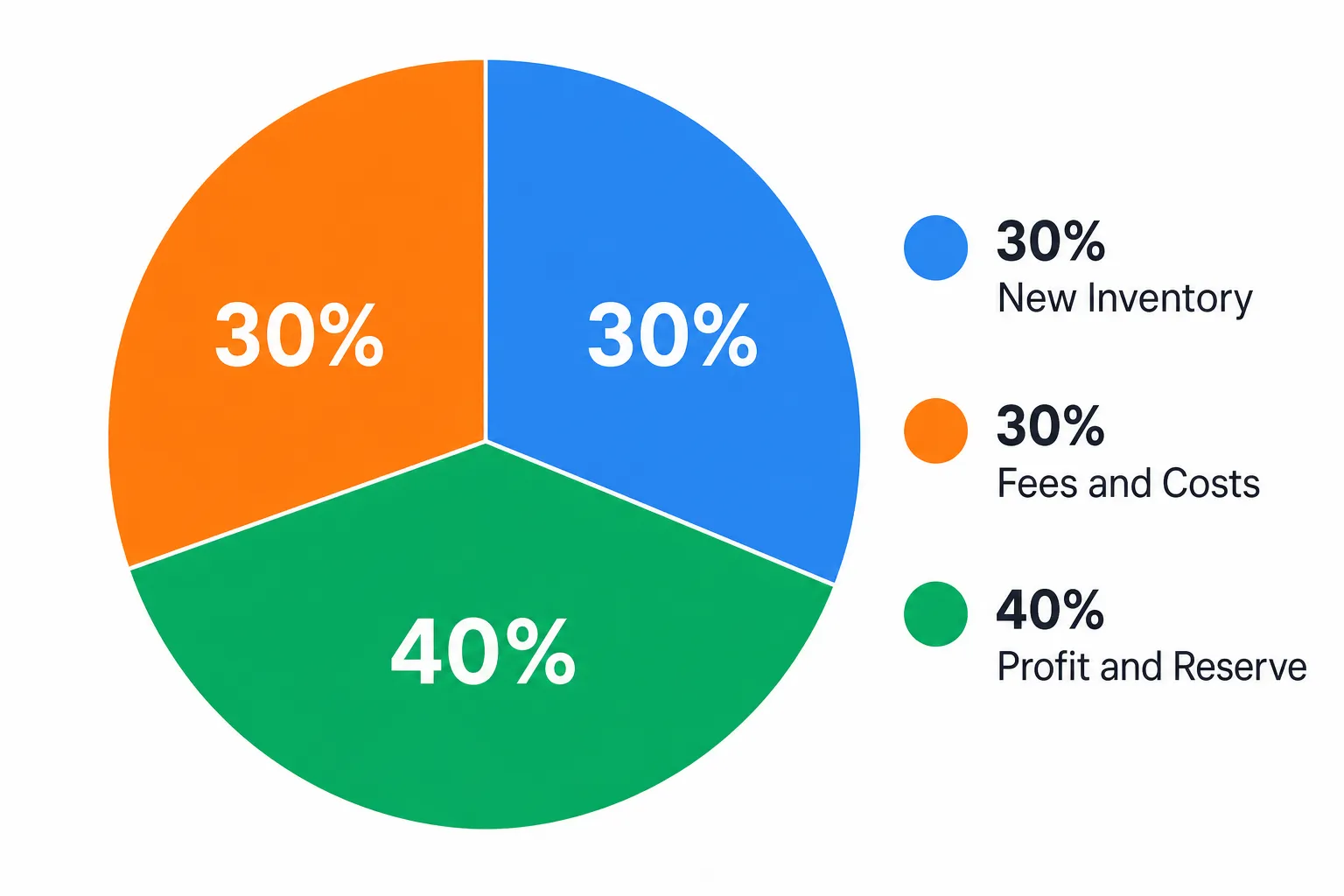
30% goes to cost of goods. This is what you spend on new inventory. If your total monthly revenue is $3,000, you're setting aside $900 for sourcing. This keeps you buying, keeps your inventory pipeline full, and funds growth.
30% covers operating costs and fees. Selling fees, shipping supplies, subscription tools, mileage, storage, photography equipment, anything that costs money to run the business. This percentage varies a lot depending on your setup.
40% is yours. This is a combination of profit you can take out and a cash reserve you're building. The specific split depends on where you are in the business. Early on, you might put most of this 40% into a savings buffer and take very little out. As that buffer grows, you shift more toward actual take-home pay.
The specific percentages aren't magic. The point is having a framework at all, rather than buying inventory until the account is empty and hoping for the best.
Inventory Turnover: The Metric That Tells You How Healthy You Are
A profitable reseller with slow turnover is at more risk than a lower-margin reseller with fast turnover. This surprises people.
Here's why. Slow-moving inventory is frozen cash. If you have $5,000 in inventory that takes an average of 90 days to sell, you have $5,000 of your capital sitting dormant most of the time. Your business is working hard to earn money, but the money just loops back into slow inventory.
A seller with the same $5,000 in inventory but a 30-day average sell-through is cycling that same capital three times as fast. They're generating three times the revenue from the same investment.
Tracking your turnover rate doesn't need to be complicated. A simple version: divide your monthly revenue by the value of your current inventory. If your monthly revenue is $2,000 and you have $6,000 in inventory at cost, your monthly turnover rate is about 0.33, meaning it takes roughly three months to sell through your inventory on average.
Most healthy reselling businesses target a 30 to 60 day average sell-through. If your turnover rate is slower than that, it's worth asking what's clogging the pipeline. Too much inventory in slow categories? Items priced too high for the market? These show up in your cash flow before they show up anywhere else.
Platform Payout Schedules and Working Around Them
One thing that catches newer sellers off guard is how different payout schedules are across platforms.
eBay payouts in managed payments are typically sent once or twice a week, or you can request instant payouts for a small fee. New accounts often have additional holds while trust is established.
Amazon takes longer. Seller funds are typically held for 14 days and then released on a biweekly schedule. This means the cash from a sale you make today might not be available to you for up to three weeks.
Facebook Marketplace pays when you mark the item as shipped and the buyer receives it. If they have issues, funds can be held further.
If you're sourcing regularly and selling across multiple platforms, you might have cash tied up in platform holds at all times. The way to manage this is to account for it like it's part of your inventory. That money exists, but you can't touch it yet. Build that reality into how you plan your buying.
The Emergency Reserve: Build It Before You Need It
The most important thing you can do to make your reselling business stable is build a cash reserve that's separate from your operating funds and your sourcing budget.
A good target for most resellers: three to four weeks of operating expenses sitting in a savings account that you don't touch unless something genuinely goes wrong. If you spend $1,000 a month on inventory, supplies, and fees, you want $750 to $1,000 in reserve.
Getting there takes time if you're starting from zero. But the approach is simple. Pick a small percentage of every payout, even 5%, and move it to a separate account automatically before you spend anything. You won't notice 5% missing. Over six months, it builds into something meaningful.
That reserve is what gives you options when things go sideways. You don't have to panic-sell good inventory. You don't have to stop sourcing when a good haul shows up. You don't have to worry every time there's a slow week.
When to Take Real Money Out of the Business
A lot of resellers, especially those who started as side hustles, never formalize the line between business money and personal money. Revenue hits the account, expenses go out, and whatever's left gets used for life. This is fine when you're small and casual. It becomes a problem as you scale.
When your monthly revenue crosses a threshold where reselling is genuinely part of your income, it's worth paying yourself an actual amount each month. A set number. Not "whatever's left." A number you decide in advance based on what the business can support.
This does two things. It forces you to be honest about whether the business actually generates enough to pay you. And it separates business cash from personal cash so you can see clearly what's happening in each.
You don't need accounting software to do this. A separate checking account for the business and a monthly transfer to your personal account is enough structure to make a real difference.
The Bottom Line
Reselling can be genuinely profitable. The margins are real, the opportunity is real, and there are people making a full-time living at it doing things they enjoy. But the financial management piece is where a lot of promising resellers struggle.
The good news is that the fix isn't complicated. You don't need an accounting degree or a business degree. You need a few basic habits: track your inventory value separately from your bank balance, set aside a sourcing budget instead of reinvesting everything, build a cash reserve before you need it, and pay yourself a real number each month.
The resellers who make it to year three, year five, year ten are usually not the ones with the best sourcing eye or the best prices. They're the ones who learned to manage cash before it became an emergency.
Start with one of these habits this month. Pick the one that feels most urgent for your situation and build from there.
How ListForge Keeps Cash Moving
The biggest cash flow lever most resellers have is listing speed. Every day an item sits unlisted is a day your money is tied up earning nothing. The gap between buying and selling is where cash flow goes to die.
ListForge compresses that gap:
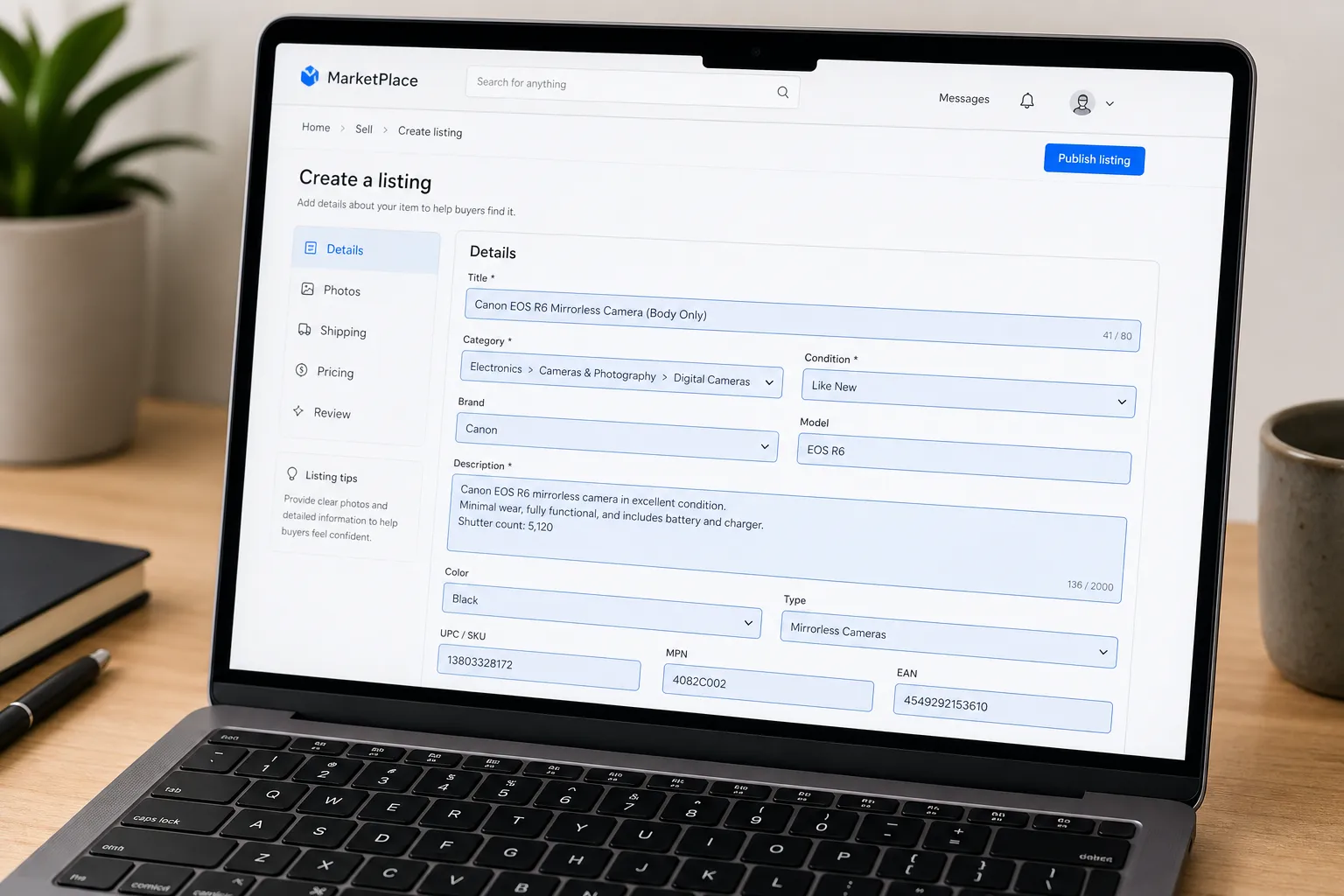
- List the same day you source. With ListForge's mobile app, you can photograph items and scan barcodes right at the source. The AI processes everything in the background, and by the time you get home, your items are identified, priced, and waiting for your review. No more "I'll list these this weekend" turning into a three-week death pile.
- Market-anchored pricing protects your margins. Every price suggestion is traced back to actual sold data and market evidence. You can see the comps and the price range before you approve. When cash flow is tight, the last thing you need is to misprice inventory because you guessed instead of researched.
- Faster listing means faster inventory turnover. If listing used to take 10 minutes per item and now takes a quick review, you can list a 30-item sourcing haul in under an hour instead of spreading it over several days. That directly improves the inventory turnover rate this article talks about, getting you closer to that 30 to 60 day sell-through target.
- Complete listings that sell faster. ListForge builds listings with full item specifics, detailed condition notes, optimized titles, and structured descriptions. Better listings get more search visibility and sell faster, which means cash comes back sooner.
The math from this article is simple: cash flow problems come from the gap between money going out (sourcing) and money coming in (sales). ListForge shrinks that gap by making listing nearly instant, so your inventory starts earning the day you buy it instead of sitting in a pile.
Try ListForge free and start turning inventory the same day you source it.