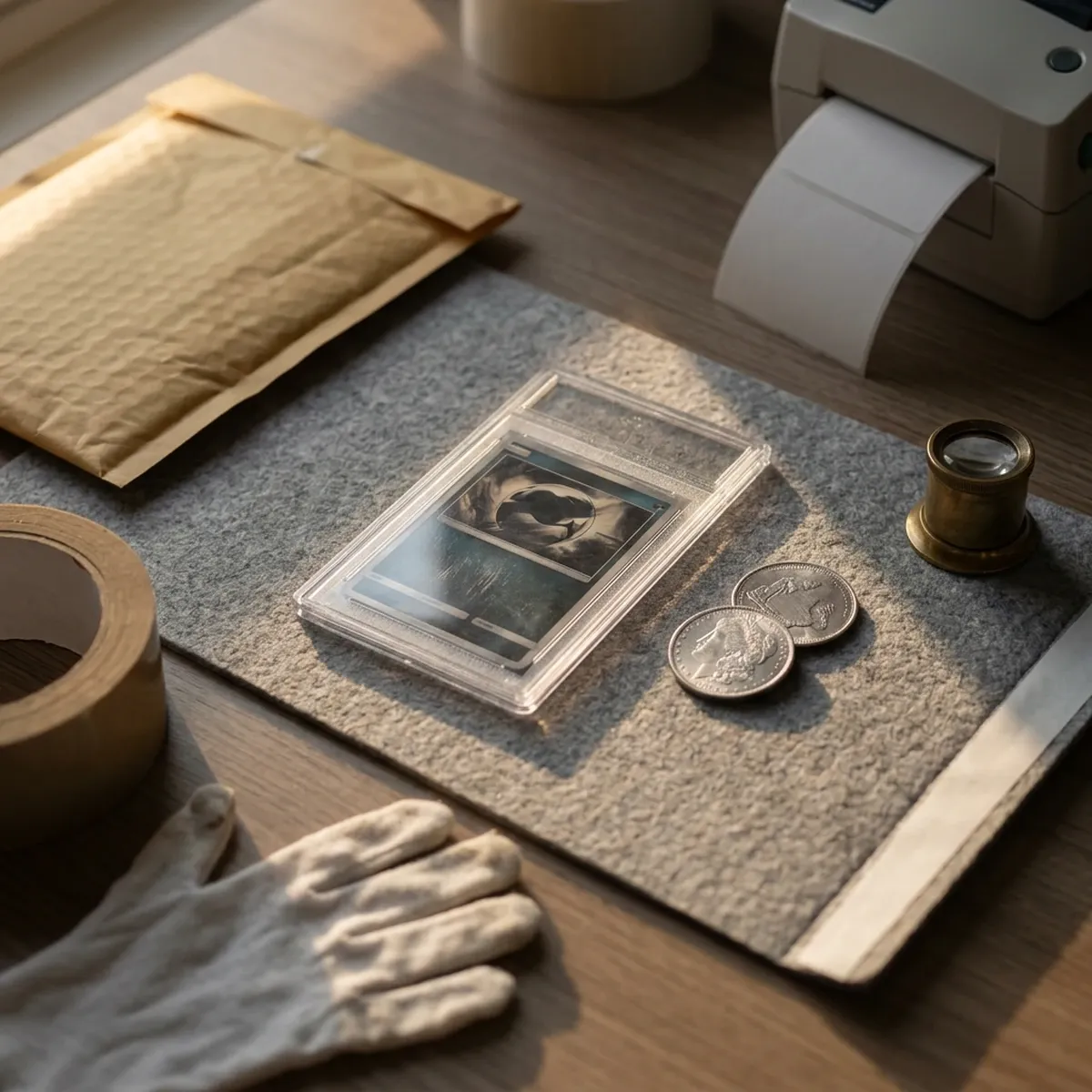
If you list a single trading card at $200, or a single coin at $500, you are not the one shipping that item anymore.
eBay is. The sale goes to an inspection facility first, gets checked against your listing, and only then goes to your buyer. You do not get asked. There is no setting to turn it off.
That line used to sit at $250 for cards, and coins were not in the program at all. Both of those things changed over the last several weeks, right as Q4 card and coin buying starts to pick up. If you sell collectibles at all, the practical shape of a sale just changed for you: where the package goes, what your photos have to prove, how long the money takes to land, and what happens when something in the listing does not match the item in the box.
Here is what actually changed and what to do about it before your next batch goes live.
The Two Price Lines That Moved
Trading cards came first. eBay dropped the Authenticity Guarantee threshold for eligible single cards from $250 to $200, covering both raw and graded cards, and said the blue checkmark would start appearing on qualifying listings over the following weeks.[2] Independent coverage put the announcement at the very end of July, with the rollout landing through August.[10] eBay's own seller page now states the requirement plainly: cards listed or sold at $200 or more, exclusive of tax and shipping.[5]
Coins are new entirely. On August 18, eBay added collectible coins to the program in the US, at $500 and up, with authentication handled by PCGS at no cost to buyer or seller.[4] Eligible coins are single graded US and world coins, plus single raw US coins. Sets, lots, and collections are out.[3]
Both changes are still listed on eBay's current September seller news page, so this is the live state of the program, not a plan.[12][11]
One more card change is coming that is worth budgeting mental space for. eBay is rolling out redesigned protective packaging this fall, with a snugger interior and a magnetic side closure, aimed at the long running complaint that raw cards shift inside the holder in transit.[9]
It is worth noting how the card line has moved. The program launched in January 2022 at $750, went to $500, settled at $250, and is now $200. Over five million cards have gone through it.[10] The direction is one way. If you are pricing cards in the $150 to $250 band today, assume this line keeps dropping and build a process that works either side of it.
You Do Not Get to Opt Out
This is the part sellers miss, so it is worth quoting directly. eBay's help page says that if your item is eligible, "it will be automatically added to the program, free of charge. There is no opt in or opt out option."[1] The coins announcement says the same thing in plainer words: there is no opt in or opt out.[3]
So the threshold is not an offer. It is a trigger. Price above it and the fulfillment path changes.
And the triggers cover more categories than most people realize. eBay's help page lists the current minimums:
- Sneakers: $100
- Apparel: $200
- Trading cards: $200
- Other shoes: $500
- Handbags and accessories: $500
- Jewelry: $500
- Coins: $500
- Watches: $2,000
Those come straight off eBay's help page, and a handful of sneaker models qualify below $100.[1]
Read that list again if you sell clothing. A $210 piece of streetwear is in the same program as a graded rookie card.[1][10] Plenty of apparel sellers have never thought about authentication because they assumed it was a sneaker and watch thing.
Your Shipping Plan Changes the Second It Sells
When an eligible item sells, eBay gives you an address that is not your buyer's address. It is the authenticator's.[1][5]
Three rules follow from that, and all three bite.
You still ship within your stated handling time. The clock does not pause because there is an extra stop. eBay's seller guidance is explicit that you ship to the authentication facility inside your normal handling window and upload tracking.[5][3]
You cannot combine orders. Each authenticated order ships individually, even if the same buyer bought three things.[3][5] If you have been bundling to save on postage, that habit breaks here.
Items at $750 and above need signature confirmation on the leg to the authenticator.[1] That is your cost and your label, and it is easy to forget when you are printing thirty labels at once.
After the inspection, the authenticator ships to the buyer. For cards, eBay states tracked delivery in four days or less, with signature required on cards at $1,500 and above.[6] You are not touching that leg.
Now the uncomfortable part. eBay's stated inspection window is one to two business days.[5][6] But eBay's own help page currently carries this notice: "Due to unprecedented market demand, some Authenticity Guarantee orders may be delayed for 7 days or more."[1] That warning is not decorative. Back in September 2025, PSA said submission volumes were "at unprecedented levels" and added roughly five business days to its estimated turnaround times, and sellers were reporting cards sitting in limbo for two to three weeks.[13] Lowering the card threshold to $200 pulls more volume into the same pipes.
Plan your handling time and your buyer communication around the seven day notice, not the two day promise.
Your Photos and Item Specifics Are Now an Inspection Checklist
This is the change that costs people money, and it has nothing to do with authenticity.
The inspector does two jobs. They verify the item is real, and they verify it matches your listing.[3][5] Fail the second one and eBay's help page is blunt about what happens: "If the inspector cannot determine that the product is authentic, or if the product is not as described in the listing, the item won't be sent on to the buyer and they will receive their money back."[1]
Not a partial refund. Not a negotiation. The sale is undone and the item comes back to you.
So the sloppy habits that used to cost you a five dollar concession now cost you the whole sale. A few specifics:
Cards need at least two photos to get the badge in the first place.[10] One hero shot is no longer enough at this price point.
For graded cards, your photos have to show the grading company, the case, the label, and the certification details, and your listing has to state them correctly.[2] If your item specifics say PSA 9 and the slab reads PSA 8, that is a rejected sale, not a haggle. eBay accepts cards graded by PSA, SGC, CGC Cards, and BGS.[6]
Authenticity Guarantee is not a grading service. eBay's card page states that in capital letters.[6] Nobody is going to upgrade your raw card or re-slab a graded one. They are checking that the thing in the box is the thing in the listing.
Your condition description has to survive a professional looking at the item. Vague is now risky. "Light edge wear" on a card an inspector reads as a crease is a mismatch, and mismatches get refunded.
The practical move here is boring and it works: photograph the flaw you are least excited about, and write it into the condition notes before the inspector finds it for you.
The Money Shows Up Later Than You Expect
Cash flow is where this quietly hurts a small operation.
eBay's payment holds policy states that "the authentication process may lead to transaction holds for up to 30 days until the authenticity of items sold with eBay's Authenticity Guarantee can be confirmed."[8]
Think about what that means in October. You sell a $600 coin on the 10th. That is not $600 of sourcing money on the 12th. It may not be sourcing money until November. If you are the kind of seller who recycles payout into the next buy, a good month of $200 to $500 collectible sales can leave you cash poor at exactly the point in the year when the good inventory shows up.
The offsetting protection is real, though, and worth knowing. eBay's feedback policy removes negative and neutral feedback when the item "was sold under our Authenticity Guarantee program, was shipped on-time and passed authentication."[7] Sellers in the community forums have been pointed at the same protection for years: ship inside your stated handling time and the authenticator's delays are not your feedback problem.[14]
That protection is conditional on you shipping on time. It is the single best reason to treat handling time as sacred on these orders.
Returns route back through the authenticator too. The buyer returns the item to the inspector, who confirms condition before it comes back to you.[1] For cards sold as final sale, eBay still allows a damaged item to be returned within three days of receipt.[6]
What to Fix Before Your Next Batch Goes Live
None of this takes long. It takes doing it before you list, not after something sells.
- Pull every active card listing priced between $190 and $260, and every coin between $450 and $600. These are the items that just crossed a line or are about to. Decide deliberately which side you want to be on.
- Add a second photo to any card listing at $200 or more. Two photos is the eligibility floor for the badge.[10]
- On graded items, read the slab out loud and check it against your item specifics. Grader, grade, certification number. Every character.
- Check your handling time on collectible listings. If you have a one day handling time and a day job, the extra leg to the authenticator is not the place to find out.
- Add signature confirmation to your process for anything over $750.[1]
- Stop promising two day authentication in your listing description. eBay's own page says seven days or more right now.[1] Set the expectation you can actually meet.
- Look at your October cash plan assuming collectible payouts land late. Up to 30 days is the stated ceiling.[8]
If you sell two or three collectibles a month, this is a fifteen minute pass. If you sell forty, it is the difference between a clean Q4 and a run of refunded sales you never saw coming.
How ListForge Keeps the Listing and the Item in Sync
The whole risk in this change comes down to one thing: a gap between what your listing claims and what a professional finds in the box. ListForge is built to close that gap before you publish, which is the only point where closing it is cheap.
- Condition is chosen from evidence, not guesswork. ListForge reads your own notes first, then any condition text printed in the photos themselves, such as tags, grading labels, and cards, then the visual assessment, then comparable listings. Your notes outrank everything.
- Graded collectibles are handled as graded, not as generic used. When the evidence shows a recognized grader and grade, ListForge selects eBay's graded condition and fills the grader, grade, and certification number fields from what it can actually see. If a required grading detail is not visible in the evidence, it leaves the field unresolved and the listing fails safely instead of publishing a number nobody verified. That is exactly the failure mode that gets a sale refunded at the inspection facility.
- Item specifics are checked against eBay's real requirements for that category before anything goes live, and if the step does not finish filling them, it says so rather than reporting success on an empty section.
- Pricing comes back as a suggested price with a low and high range from live comparable data, so when an item lands near $200 or $500 you can see the spread and make the threshold call on purpose instead of by accident.
- Nothing publishes without your approval. Finished drafts land in the Tasks queue marked ready to publish. Anything blocked shows you the specific issue and a link to fix it, so you are approving a listing you have actually looked at.
The thresholds will keep moving down. A listing process that assumes a professional will inspect the item is the one that stops caring where the line sits.
Sources
[1] https://www.ebay.com/help/selling/selling-tools/ebay-authenticity-guarantee?id=4644 - eBay Help: Selling with Authenticity Guarantee [2] https://community.ebay.com/forum/announcements-57928/topic/authenticity-guarantee-is-expanding-to-more-trading-cards-469377 - eBay Announcements: Authenticity Guarantee is expanding to more trading cards [3] https://community.ebay.com/forum/announcements-57928/topic/introducing-authenticity-guarantee-for-coins-470520 - eBay Announcements: Introducing Authenticity Guarantee for coins [4] https://www.ebayinc.com/stories/news/ebay-authenticity-guarantee-collectible-coins - eBay Inc.: eBay Expands Authenticity Guarantee to Collectible Coins [5] https://pages.ebay.com/authenticity-guarantee-tradingcards-seller - eBay: Authenticity Guarantee for Trading Cards, seller guide [6] https://www.ebay.com/authenticity-guarantee/tradingcards - eBay: Authenticity Guarantee for Trading Cards program page [7] https://www.ebay.com/help/policies/feedback-policies/feedback-policies?id=4208 - eBay Help: Feedback policy [8] https://export.ebay.com/en/fees-regulations-policies/transactions/payment-holds - eBay: Payments on hold [9] https://www.valueaddedresource.net/ebay-trading-card-threshold-packaging-updates - Value Added Resource: eBay Drops Trading Card Authentication Threshold To 200 Dollars, Updates Packaging [10] https://www.si.com/collectibles/ebay-authenticity-introduces-new-lower-threshold-guarantee-program - Sports Illustrated: eBay's Authenticity Guarantee Now Covers Cards as Low as 200 Dollars [11] https://www.valueaddedresource.net/ebay-september-2026-seller-news - Value Added Resource: eBay September 2026 Seller News [12] https://www.ebay.com/sellercenter/news/2026-september - eBay Seller Center: Seller News September 2026 [13] https://www.valueaddedresource.net/ebay-psa-trading-card-authentication-delays - Value Added Resource: eBay Authentication Delays Persist As PSA Pushes Back Trading Card Processing Timeframe [14] https://community.ebay.com/forum/selling-57920/topic/getting-worried-ebay-authenticator-taking-too-long-and-tcg-pokemon-117219 - eBay Community: Getting Worried, eBay Authenticator Taking Too Long